Engineering Team ·
A Buyer's Guide to Structural Steel Sections: I-Beam, H-Beam, Channel, and Angle
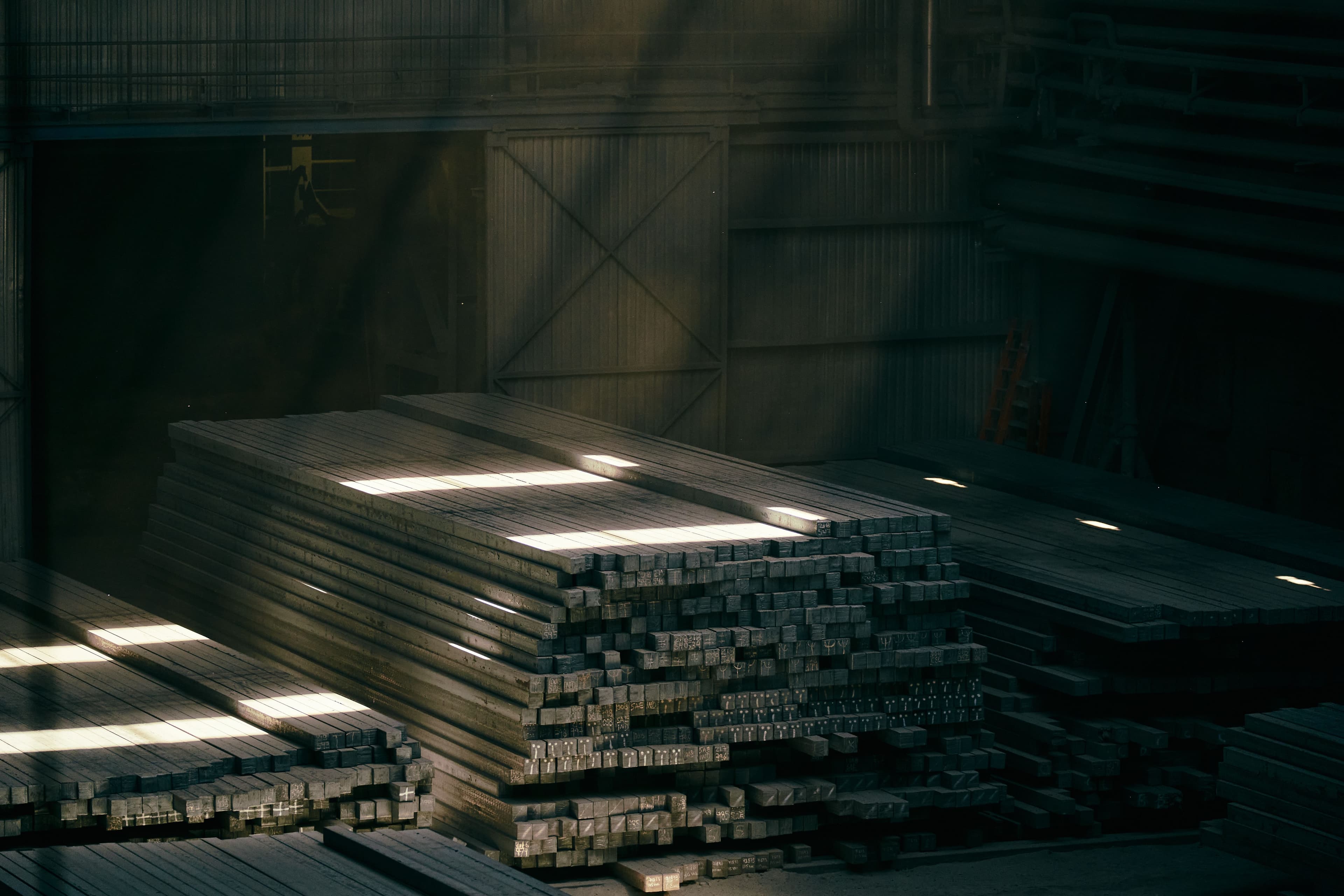
If you're new to specifying or purchasing structural steel, the range of section shapes on a supplier's product list can look more confusing than it needs to be. Four sections in particular — I-Beam, H-Beam, Channel, and Angle — cover the large majority of general structural framing needs, and each has a distinct shape and structural role worth understanding.
I-Beam: the classic beam shape
An I-Beam (in the Indian Standard system, an ISMB section) has the cross-sectional shape of the letter "I" — two horizontal flanges connected by a vertical web. This shape is efficient at resisting bending in one direction, which is exactly the load pattern a horizontal beam experiences when it carries load from above and spans between two supports. I-Beams are a common choice for floor beams, roof beams, and girders in general construction.
H-Beam: built for columns and heavy loads
An H-Beam looks similar to an I-Beam at a glance, but its flanges are wider and thicker relative to its depth, giving it significantly better resistance to bending about both axes rather than just one. This makes H-Beams well suited to columns, which need to resist loads and forces from multiple directions (vertical load plus lateral forces like wind), and to situations with especially heavy point loads. As a rule of thumb, if a section's role is primarily to support a vertical load as a column, an H-Beam is usually the more appropriate choice over an I-Beam.
Channel: lighter framing and secondary support
A Channel section (ISMC in the Indian Standard system) has a "C" shaped cross-section — a web with two flanges on only one side. Channels are lighter than beams of similar depth and are commonly used for secondary structural elements: roof purlins, wall girts, and framing members that don't carry the full primary load path of a structure. They're also frequently used in pairs, back-to-back, to create a stronger built-up section for slightly heavier applications.
Angle: the most versatile light section
An Angle section has an "L" shaped cross-section, available in equal-leg (both sides the same length) and unequal-leg configurations. Angles are the most versatile of the four sections covered here — used for bracing, brackets, light framing, and as the primary structural element in lattice-type structures like transmission towers, where many angle sections are combined into a rigid three-dimensional frame.
How to tell which one you need
If you're working from a structural engineer's drawing, the section and size will already be specified — the descriptions above are mainly useful for understanding why that particular section was chosen. If you're specifying framing yourself for a smaller, non-critical structure, the general pattern holds: I-Beams and H-Beams for primary beams and columns respectively, Channels for secondary framing, and Angles for bracing, brackets, and light lattice structures. For anything load-bearing on a project where safety is a real concern, it's worth having a structural engineer confirm the section and size rather than relying on general guidance alone.